YouTuber Claims to Recreate Coca-Cola’s Secret Formula Through Chemical Analysis
A science-focused YouTuber says he has recreated Coca-Cola’s closely guarded formula by treating the drink as a chemistry problem. The creator, known online as LabCoatz, published a January video detailing a year-long effort to analyze Coca-Cola at the molecular level and rebuild it using laboratory tools and repeatable measurements.
The claim has circulated widely on social media and in news outlets, though Coca-Cola has neither verified nor commented on the results.
Treating Cola Like a Lab Sample
According to LabCoatz, the project began with a question: if the ingredients listed on a Coca-Cola label are public, what exactly is contained within the vague category of “natural flavors”?
Rather than relying on leaked recipes or flavor reconstructions, the YouTuber says he used chemical analysis to isolate compounds and map their proportions. Working with collaborators who had access to scientific equipment, LabCoatz used mass spectrometry to analyze the beverage and identify its chemical signatures.
Mass spectrometers separate compounds based on their mass-to-charge ratios, allowing researchers to identify which molecules are present and their relative concentrations. Those readings served as a reference point for rebuilding the drink piece by piece.
Focusing on the “Natural Flavors” Label
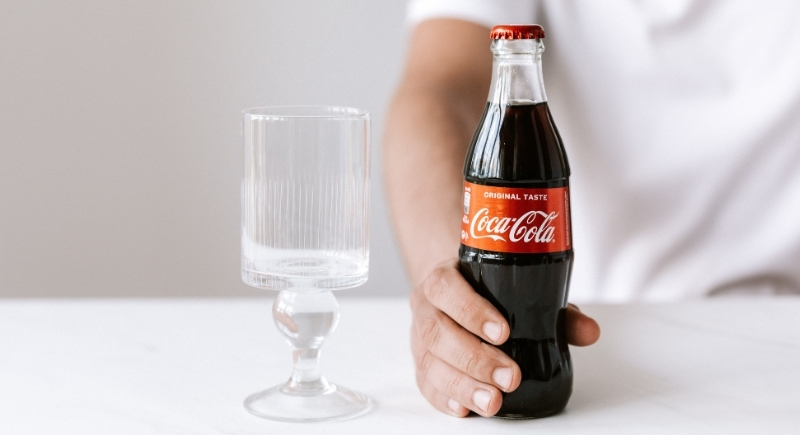
Image via Pexels/Karola G
Coca-Cola’s formula has remained secret for more than a century, largely because the most distinctive part of the recipe is hidden behind the “natural flavors” designation.
LabCoatz says his analysis pointed to a blend of citrus oils, spices, and plant-derived compounds that together account for less than 1% of the final beverage but drive most of its recognizable flavor.
In interviews and in the video, he explains that the reconstructed flavor profile included lemon, lime, and orange oils, along with cinnamon, nutmeg, coriander, vanilla, and tannins. Small quantities of acids, including vinegar, were also included to match the drink’s sharpness.
After months of testing and adjustments, LabCoatz released a recipe and said the final result was chemically identical to Coca-Cola based on his measurements. He also shared that informal taste tests with volunteers failed to distinguish his version from the commercial product.
These conclusions remain self-reported. No independent laboratory has published a peer-reviewed analysis confirming the equivalence, and Coca-Cola has not responded publicly to the claims. The company has historically declined to discuss its formula beyond what is required on ingredient labels.
Why the Formula Remains Officially Secret
Image via Getty Images/DNY59
Coca-Cola’s recipe is famously protected as a trade secret. Patenting a formula requires full public disclosure, whereas trade secret protection allows the company to keep details private indefinitely, as long as reasonable steps are taken to maintain secrecy.
LabCoatz notes this distinction in his video, explaining that recreating a formula through analysis does not violate patent law. The statement reflects his interpretation of the situation. Trademark protections, branding, and commercial use are separate issues that remain under Coca-Cola’s control.
What This Experiment Does—and Doesn’t—Show
The project shows how modern analytical tools can dissect complex flavors with a level of precision that was unavailable when Coca-Cola was created in the late 1800s. Mass spectrometry and related techniques are already used throughout the food and beverage industry for quality control and product development.
At the same time, reproducing a chemical profile does not necessarily replicate every aspect of an industrial process. Factors such as sourcing, processing methods, carbonation techniques, and scaling can influence taste and stability.
LabCoatz acknowledges that while his recipe may match the drink’s composition, Coca-Cola’s proprietary production methods remain unknown.