This Jet-Black Apple Tastes Like Honey and It Only Grows in One Place
High in the mountains of Nyingchi, a city in Tibet, apples grow that look strikingly different from the varieties found in grocery stores. Their skin deepens into a dark purple so intense that it appears black, while the flesh inside remains pale, firm, and crisp. These are known as Black Diamond apples, a rare cultivar whose appearance is heavily shaped by the environment in which they grow.
Black Diamond apples exist because of a specific combination of altitude, climate, and sunlight. Those same conditions also explain why they are grown in only one region and why their appearance and flavor are difficult to reproduce elsewhere.
Where Black Diamond Apples Come From
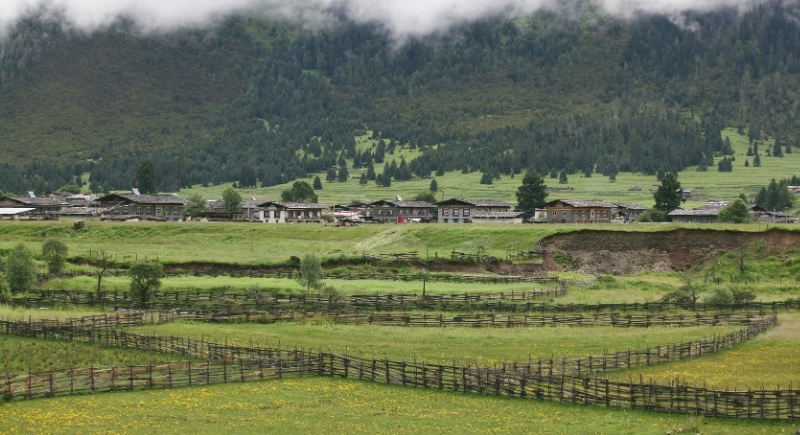
Image via Getty Images/Dylan Zheng
Black Diamond apples belong to the Huaniu family, a Chinese cultivar of the Red Delicious variety. They are grown exclusively in the Tibetan region around Nyingchi, a mountainous area governed by China and situated at elevations ranging from 9,800 to 10,000 feet (approximately 3,000 meters) above sea level.
This location matters. Nyingchi experiences intense sunlight during the day and sharp temperature drops at night. In a single 24-hour period, temperatures can swing from around 85°F to well below freezing. The combination of high ultraviolet exposure and cold nights triggers the production of anthocyanins, the pigments responsible for the apple’s unusually dark skin.
The color develops slowly over time. Even then, not every apple reaches the same depth of purple-black. The darkest fruit is usually selected for high-end markets, while lighter ones remain local.
Apple That Looks Almost Black
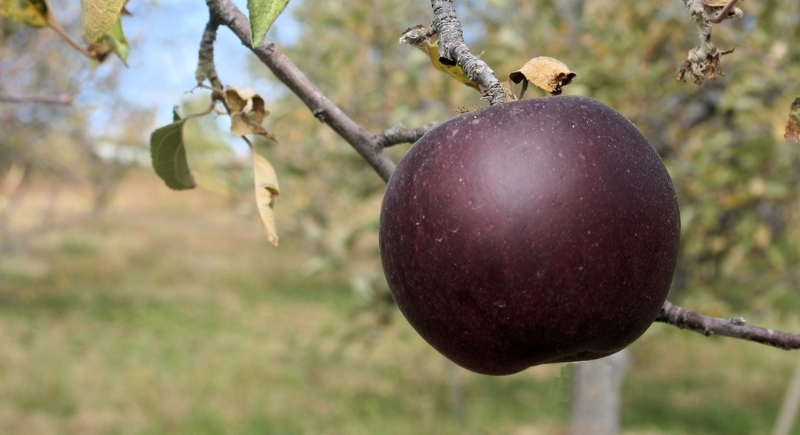
Image via Getty Images/BehindTheLens
Despite the name, Black Diamond apples are not truly black in color. Their skin is a deep purple, similar to a ripe plum, but the saturation is so strong that it appears black under most lighting.
Intense UV radiation at high elevations stresses the fruit, prompting it to produce more pigment as a form of protection. The cool nights slow the ripening process, allowing color compounds to build gradually instead of breaking down. Inside, the flesh is white, firm, and dense, with a structure similar to Red Delicious apples.
Growers and buyers consistently describe Black Diamond apples as very sweet, often comparing the flavor to honey. The sweetness is paired with a crisp bite rather than a soft texture.
Because the apples are rarely exported and almost never sold outside China, most people never get the chance to taste one. That means flavor descriptions only come from orchard operators, specialty retailers, and limited consumer reports.
The apples fall into the luxury fruit category in China, where appearance, texture, and sweetness all contribute to demand.
Why They Are So Rare
Several factors keep Black Diamond apples scarce. First, the trees take time. Farmers typically wait up to eight years after planting before the trees produce fruit. Second, the growing season is short. Apples are harvested for only about two months each year. Third, the environment cannot be easily recreated. Attempts to grow Black Diamond apples outside Tibet, including in other parts of China, have failed to produce the same color and quality. Because of the long wait, limited yield, and high risk, many farmers choose not to grow them at all.
In major Chinese cities, such as Beijing and Shenzhen, Black Diamond apples are sold in high-end supermarkets and gift shops. Prices usually range from $7 to $20 per apple, depending on size, color depth, and season. They are often packaged individually or in small presentation boxes, similar to luxury fruit in Japan.
You cannot Buy Them in the United States

Image via Getty Images/zhudifeng
Black Diamond apples are not exported outside China. No commercial grower currently ships them internationally, and no licensed orchards are producing them elsewhere.
While the apples appear frequently online, many images are mislabeled or enhanced. Some photos circulating on social platforms show unrelated dark apple varieties or heavily edited fruit.
For buyers in the United States, the closest alternatives are heirloom apples with dark skins, such as Arkansas Black or Black Oxford apples. These varieties can develop deep coloration and increased sweetness after long cold storage, though they are genetically and geographically unrelated to Black Diamond apples.