The Surprising Origins of the Fortune Cookie and Its Misleading Chinese Identity
Fortune cookies are so closely associated with Chinese restaurants in the United States that many people assume they came straight from China. But history says otherwise.
The earliest version of the cookie dates back to Japan in the late 19th century. Bakeries near Kyoto made a cracker called tsujiura senbei, which held small fortunes inside. These crackers looked similar in shape but tasted very different. They were larger, darker, and flavored with sesame and miso rather than vanilla and butter used today.
Research by Yasuko Nakamachi uncovered both physical examples of these cookies and illustrated storybooks from 1878 showing workers making them.
How It Reached American Shores
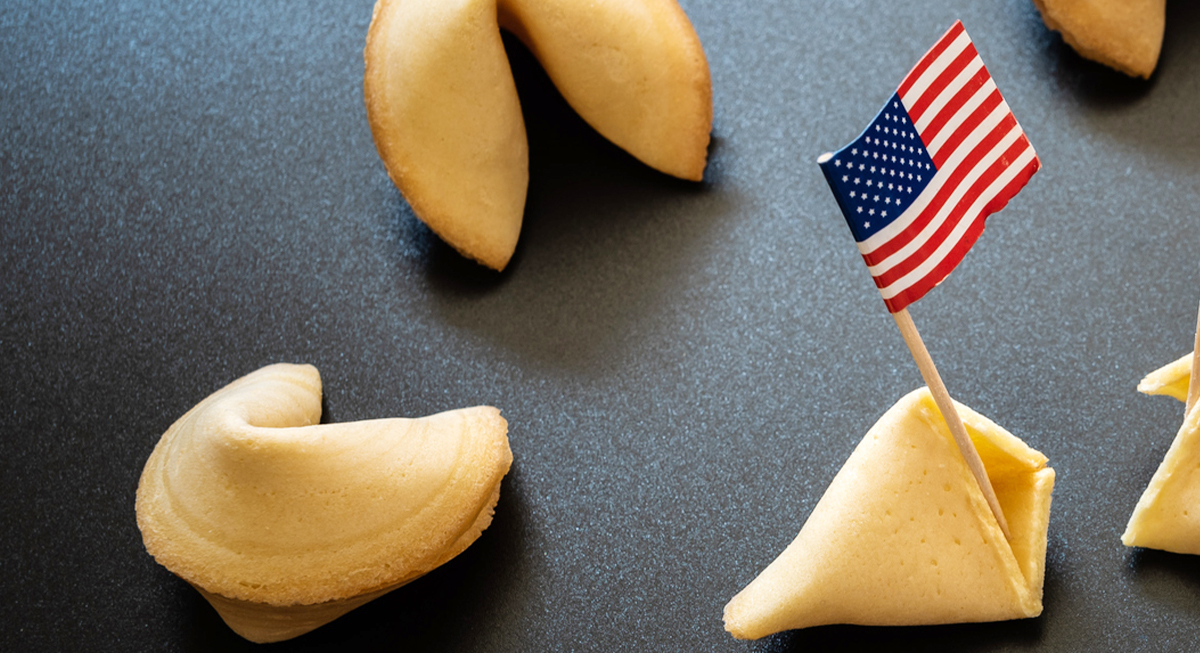
Image via iStockphoto/CorbalanStudio
The cookies reached America when Japanese immigrants arrived in the United States between the late 1800s and early 1900s. Many settled in California and Hawaii, opening bakeries that produced familiar snacks, including versions of these fortune-filled crackers.
By the early 1900s, those cookies began appearing in places like San Francisco and Los Angeles. Some accounts point to the Japanese Tea Garden in San Francisco’s Golden Gate Park as an early site where they were served, with supplies from a bakery called Benkyodo. Around the same time, businesses like Fugetsu-Do, Umeya, and the Hong Kong Noodle Company also claimed a role in shaping the cookie’s early presence in America.
Many Chinese restaurants did not offer dessert at the time, so they began serving these cookies sourced from nearby Japanese bakeries. By roughly 1907 to 1914, the cookies were already part of the dining experience in some Chinese eateries.
The Turning Point During World War II

Image via Canva/ASphotostudio
After the attack on Pearl Harbor in 1941, President Franklin D. Roosevelt signed Executive Order 9066 in 1942. The order forced Japanese Americans into internment camps. Most Japanese-owned businesses closed almost overnight, including many bakeries that had been producing fortune cookies.
With those bakeries gone, Chinese American entrepreneurs stepped in to fill the gap. They began producing and distributing the cookies on a larger scale, especially to Chinese restaurants that were already serving them. Thus, a product that started in Japanese communities became widely produced by Chinese American businesses. Over time, the origin story faded, and the cookie became seen as part of Chinese cuisine.
Growth, Machines, And A Billion-Cookie Industry
By the late 1950s, dozens of bakeries were producing around 250 million cookies each year. In the 1960s, Edward Louie founded Lotus Fortune in San Francisco and developed an automatic machine that sped up production. The innovation helped turn the cookie into a standard feature across restaurants.
Today, the numbers are massive. Wonton Food, based in Queens, New York, produces more than 4 million fortune cookies daily. Estimates place annual production at around 3 billion cookies, almost all of which are made in the United States.
The company even employs a Chief Fortune Writer to create messages. Early fortunes leaned toward predictions like “You will be successful.” Modern ones focus more on short, upbeat lines. In 2005, a batch of lucky numbers printed on these cookies led more than 100 lottery players to share a $19 million jackpot.
Even with clear historical roots, the perception of fortune cookies as Chinese never really changed. American diners experienced them in Chinese restaurants, so the connection has felt natural and stuck over time.
Attempts to introduce fortune cookies in China did not gain traction, partly because people there did not recognize them as part of their own food culture. In some cases, diners even ate the paper fortunes by mistake, unfamiliar with the concept.