The Most Embarrassing Fast Food Failures That Chains Are Praying You Forgot
Fast food chains spend billions of dollars refining menus, testing marketing campaigns, and protecting their brand images. Yet even the biggest names in the industry have moments they would rather erase from public memory. Here are some fast food failures that went beyond simple miscalculations and became full-blown corporate embarrassments.
McDonald’s Accidentally Gave Away the Olympics
The idea sounded harmless enough: reward customers when American athletes won medals at the 1984 Olympics. What McDonald’s did not plan for was the Soviet Union’s boycott, which cleared the field for the United States to dominate the Games.
With 174 medals secured by Team USA, franchises were flooded with customers demanding free Big Macs, fries, and drinks. Locations ran low on inventory, and losses mounted quickly. Decades later, McDonald’s still avoids discussing how much the promotion actually cost.
Burger King’s Fries That Nobody Asked For
Satisfries arrived in 2013 after years of development. It was pitched as containing fewer calories and fat, positioned as a smarter alternative to traditional fries.
Customers saw them as a downgrade, so sales lagged, and franchises resisted carrying them. Within a year, most locations had dropped the product entirely. The failure reinforced a familiar lesson: health messaging does not always align with expectations for fast food.
When KFC Became a Chicken Restaurant Without Chicken
Changing logistics partners should not make national headlines. But KFC managed to do exactly that in the UK. A supplier switch in 2018 left hundreds of locations without poultry, resulting in temporary closures nationwide.
The brand recovered, but the incident exposed how thin the margin for error can be when a chain’s identity depends on a single ingredient. Social media was filled with jokes, memes, and frustration, while KFC issued apologies that leaned heavily on humor.
McDonald’s Asked for Memories and Got Complaints Instead
The #McDStories hashtag was meant to invite nostalgia. Instead, it became a dumping ground for grievances.
Launched in 2012, the campaign encouraged customers to share heartwarming experiences tied to the brand. Within hours, the hashtag was overwhelmed with negative stories about food quality, service, and workplace issues. McDonald’s pulled the campaign within two days.
Burger King’s Tweet That Needed No Context and All of It
In 2021, Burger King UK attempted to draw attention to gender inequality in professional kitchens. The campaign opened with a tweet that read, “Women belong in the kitchen.”
Although a follow-up explanation clarified the intent, the opening line traveled faster than the context. Screenshots spread, outrage followed, and the brand was forced into damage control. The apology came quickly, but the episode became a cautionary tale about provocation without precision.
A&W Lost a Math Problem to Public Perception
A&W’s Third Pound Burger should have been a winner. More beef than McDonald’s Quarter Pounder at the same price sounded like an easy sell. Customers disagreed.
Market research later revealed that many people believed one-third of a pound was smaller than one-quarter. No amount of advertising could fix the misunderstanding. The burger disappeared, remembered less for its flavor than for what it revealed about consumer psychology.
Burger King Spent Millions Looking for Someone Nobody Cared About
In the mid-1980s, Burger King introduced “Herb,” a fictional man who had never eaten at the chain. Customers were encouraged to spot him in restaurants for cash rewards.
The campaign dragged on for weeks, aired during the Super Bowl, and cost roughly $40 million. Still, sales did not improve. People’s confusion outweighed their curiosity, and the character never resonated. Shortly afterward, Burger King changed ad agencies, effectively closing the book on the experiment.
McDonald’s Tried to Grow Up and No One Followed
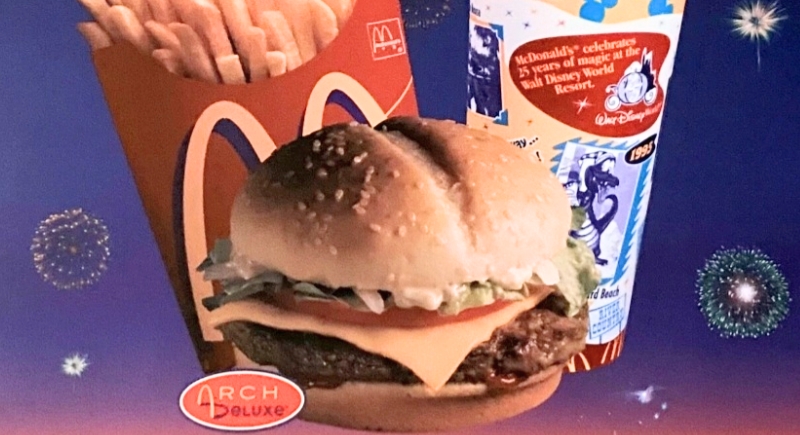
Image via Facebook/Greasy News
The Arch Deluxe was designed for adults who had supposedly outgrown standard fast food. The chain reportedly spent around $200 million on its development and promotion. It came with upscale marketing, premium pricing, and expectations of massive returns.
What it did not come with was demand. Younger customers stuck with cheaper favorites, while older diners saw no reason to pay more at McDonald’s.
McDonald’s McAfrika and Bad Timing
In 2002, McDonald’s Norway launched the McAfrika, a pita-style sandwich marketed as internationally inspired. The timing proved disastrous.
The product debuted while severe famine affected millions across Africa. Critics accused the chain of cultural insensitivity, particularly in one of Europe’s wealthiest countries. McDonald’s defended the product but ultimately allowed humanitarian fundraising inside restaurants, signaling the backlash had landed.
Chipotle’s Crisis That Could Not Be Spun Away

Image via Wikimedia Commons/MiosotisJade
Some marketing missteps blow over. Food safety failures linger. Between 2015 and 2018, Chipotle was connected to several foodborne illness outbreaks across the United States, sickening more than 1,100 people. In 2020, the company agreed to pay a $25 million criminal fine, the largest of its kind in a food safety case. The brand endured, but only after doing the work to earn trust back.