Remember When McDonald’s Launched McPlane, a Flying Restaurant?
In 1996, McDonald’s partnered with Swiss regional carrier Crossair on a project that went beyond co-branding. A McDonnell Douglas MD-83 was selected and reworked inside and out. The cabin featured red-and-yellow interiors, branded packaging, and themed uniforms, while the exterior wore the unmistakable golden arches across the fuselage.
This aircraft operated on European leisure routes tied to package holidays. The goal was to increase brand visibility. Traditional advertising struggled to cut through crowded markets at the time, and a flying restaurant could generate coverage across borders without buying airtime.
Turning A Jet Into A Restaurant
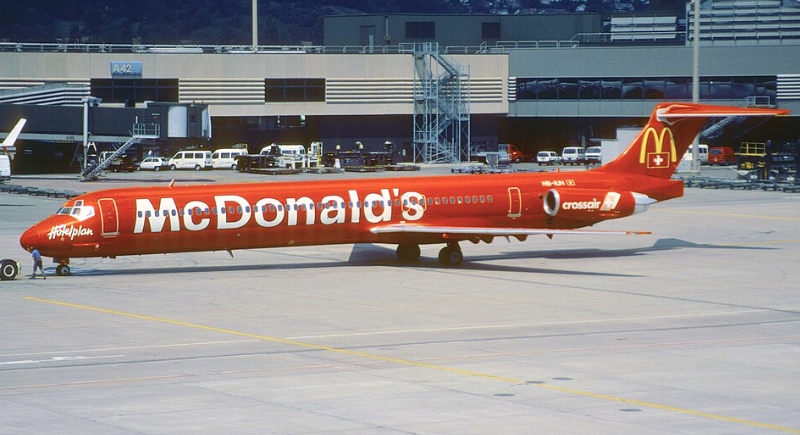
Image via Wikimedia Commons/Aero Icarus
The aircraft itself, a McDonnell Douglas MD-83, offered enough cabin space to support modified galleys and branded service flow. Food preparation was simple by necessity. Burgers and chicken nuggets were reheated on board, and milkshakes proved harder to manage in volume. French fries never made it into service due to fire risk and storage limits.
Passengers received meals in familiar packaging while seated in a space that looked like a promotional exhibit. Flight attendants wore McDonald’s uniforms, and boarding alone set expectations before anyone sat down.
Why The Idea Made Sense At The Time
Image via iStockphoto/PhonlamaiPhoto
McDonald’s expanded rapidly across Europe during the mid-1990s. Local competition varied by country, and brand dominance was not guaranteed. A project like McPlane turned a familiar logo into a moving landmark. The aircraft crossed borders daily and reached audiences that traditional ads could not reach as directly.
Crossair also gained from the arrangement. Regional airlines often struggle to gain popularity, and this campaign would solve the problem overnight. Aviation publications, newspapers, and television outlets covered the aircraft extensively. The airline gained name recognition well beyond its route map.
The Practical Limits Became Clear Fast
Running a restaurant in the air brought constraints that branding could not solve. Food quality dropped when reheated, service took longer than standard airline catering, and equipment changes added cost and complexity. Regulatory requirements limited menu flexibility.
Passengers enjoyed the novelty, but repeat demand stayed uncertain. The experience worked best as a story to tell rather than a service to rely on. Over time, the aircraft returned to routine operations.