Little Caesars Is Testing a Heavy-Duty Drone Built for Massive Food Orders
Little Caesars has started testing a new drone delivery system in Wylie, Texas, using a heavy-duty aircraft called the Sky2. Built by drone company Flytrex, the machine can carry up to 8.8 pounds of food per trip. That is enough for two large 16-inch pizzas, sides, and drinks without splitting the order into multiple runs.
Most food delivery drones have focused on lighter items, such as coffee, snacks, or a single meal. Family-sized takeout has been a bigger challenge because larger payloads demand more stability, stronger motors, and longer flight reliability. Flytrex tackled that by building the Sky2 as an octocopter, meaning it uses eight rotors instead of the four or six found on many commercial drones.
The Pizza Arrives in About Four Minutes
Image via Getty Images/webphotographeer
The current test is limited to customers within four miles of the Little Caesars location in Wylie, a Dallas suburb. Orders are processed through the Flytrex app and connect directly to the restaurant’s ordering system. Once the food is ready, the drone picks it up outside the store and heads straight to the customer’s home.
The average delivery time is around 4.5 minutes after the pizza leaves the oven. The Sky2 also never lands in a customer’s yard. Instead, it hovers overhead and lowers the order down on a wire before flying away again. The setup probably sounds futuristic because, until recently, it mostly was.
Food Delivery Companies Are Racing Into the Sky
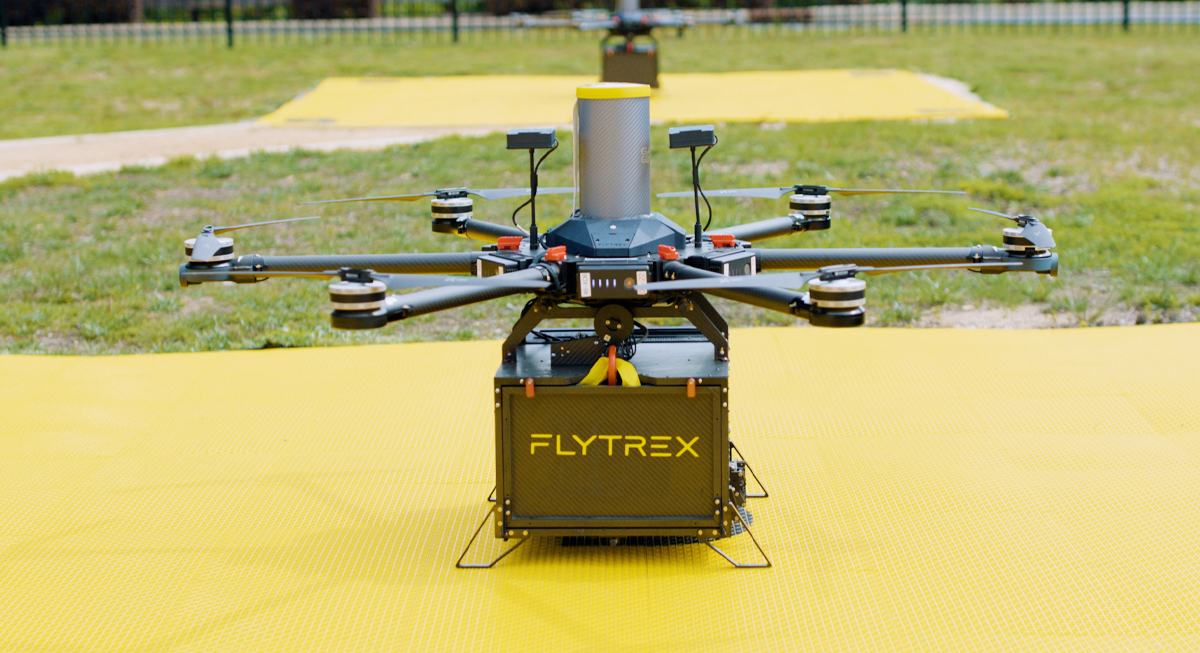
Image via Wikimedia Commons/NinaHirsch
Little Caesars is not the only chain experimenting with airborne delivery. The restaurant industry has spent the past few years testing drones across several states.
Chipotle launched its “Zipotle” drone partnership with Zipline in Texas last year. Walmart expanded its own drone plans with Wing and said it aims to build a network of more than 270 drone delivery locations by 2027. DoorDash has also teamed up with both Flytrex and Wing in different markets.
Flytrex itself already works with chains including Jersey Mike’s, El Pollo Loco, Raising Cane’s, and Chick-fil-A. The company even received investment money from Uber in 2025 as the drone delivery market started heating up.
The numbers behind the industry are getting bigger. Consulting firm McKinsey & Company estimates commercial drone deliveries in the United States could hit 1.5 billion annually by 2035.
The Bigger Challenge Might Be Public Reaction
The technology is improving quickly, but public enthusiasm is more complicated. Drone delivery solves several headaches at once: food arrives faster, drivers avoid traffic, restaurants can handle more orders during peak hours, and customers spend less time waiting around for dinner. Still, the idea of large drones constantly flying above suburban neighborhoods already has critics raising concerns about noise, safety, and crowded airspace.
Some online reactions to the Little Caesars rollout focused less on pizza and more on what daily drone traffic could eventually look like in residential areas. Others questioned how well the system would work in cities with taller buildings, dense tree cover, or densely packed power lines.
Those concerns probably explain why companies keep launching in suburban areas first. Wylie offers shorter distances, open layouts, and easier flight paths than places like New York or Chicago.